
The shop that shaped the software.
MonuOS is built alongside Trinity Monuments, a real, operating monument shop. This is the story of how one shop's day-to-day work — the orders, the artwork, the photos, the installs — became the blueprint for the platform, and how features are proven against genuine monument work before they ship.
By Steven, owner of Trinity Monuments · Published July 17, 2026
A working monument shop, not a lab.
Trinity Monuments does what monument shops do: takes orders from families and funeral homes, designs and proofs memorials, prepares artwork and photos for production, cuts and blasts stencils, and installs finished stones in cemeteries. That real workload is exactly what MonuOS is built and tested against.
The problem
The work was scattered across spreadsheets, texts, email, and outside services. Photo prep and artwork-to-stencil were slow and manual, and families called constantly for status.
The approach
Build one platform that covers the whole shop — and prove each piece on Trinity's actual orders, files, and artwork rather than on demo data.
The evidence
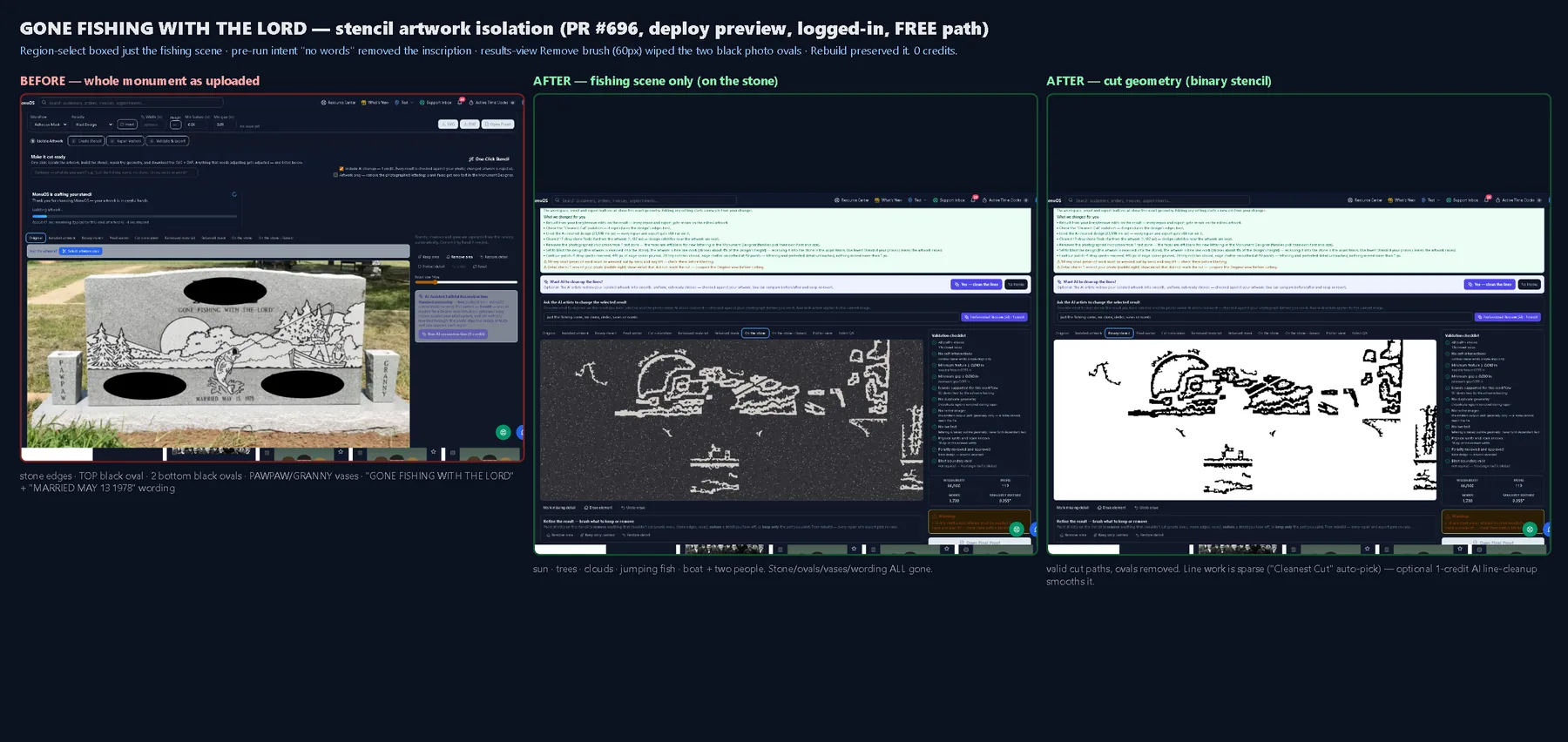
The screenshots below are from a real MonuOS run on a genuine monument, not a mockup — including the sandblast-stencil isolation of a finished "Gone Fishing With The Lord" stone.
From a photo of a finished stone to cut-ready geometry.
One of the hardest everyday jobs — pulling clean, cut-ready artwork out of a photograph — is a good measure of whether software really understands the trade. Here is that job, run in MonuOS on a real monument.
Isolate the artwork
A region box and a plain-language instruction scoped the run to just the fishing scene and dropped the granite, the photo ovals, the vases, and the photographed inscription — before any file was built. See the stencil studio →
Validate before export
The stencil passed a validation checklist — closed paths, feature and gap floors, no live text, no raster, known physical scale — and downloads stayed locked until the SVG and DXF agreed.
Free path, real cost control
The isolation ran on the free path with no AI credits spent; the optional AI line-cleanup is a one-credit polish. Costs a shop can predict.
The rest of the shop, on the same platform.
The stencil is one job. The reason it matters to Trinity is that it lives in the same place as everything else the shop runs.
Orders & proofs
Quotes that convert to orders in one click, no-login proof approvals, and a production board the office and shop floor share. Shop management →
Photos for engraving
Restoring and preparing family photos — background removal, restore, colorize, photo-to-laser — with several versions to choose from. Laser & photo prep →
Families in the loop
No-login tracking links and consent-based milestone texts answer "how's the stone coming?" before the phone rings. All features →
Measured honestly.
We only publish outcomes we can stand behind. The qualitative result is clear from the worked example above; specific figures will be added once the shop confirms them.
What's demonstrated today
A photo of a finished monument was turned into isolated, validated, plotter-ready SVG and DXF cut geometry in the live platform — on the free path — with the stone, ovals, vases, and lettering removed and the geometry validated before export.
In the owner's words
Steven, who owns and runs Trinity Monuments, points to what changed his week: “The hours saved are huge. The biggest thing is the notifications — if I miss something, the system reminds me. I can update a customer's progress live, and I can pull up all my customers right on my phone.” These are his first-hand results; specific figures (hours per week, order counts) will be added as the shop tracks them.
Run your own shop's work through MonuOS.
Start a free trial and put a real order, a real photo, and a real piece of artwork through the platform that a working monument shop helped build.
Get started About MonuOS